
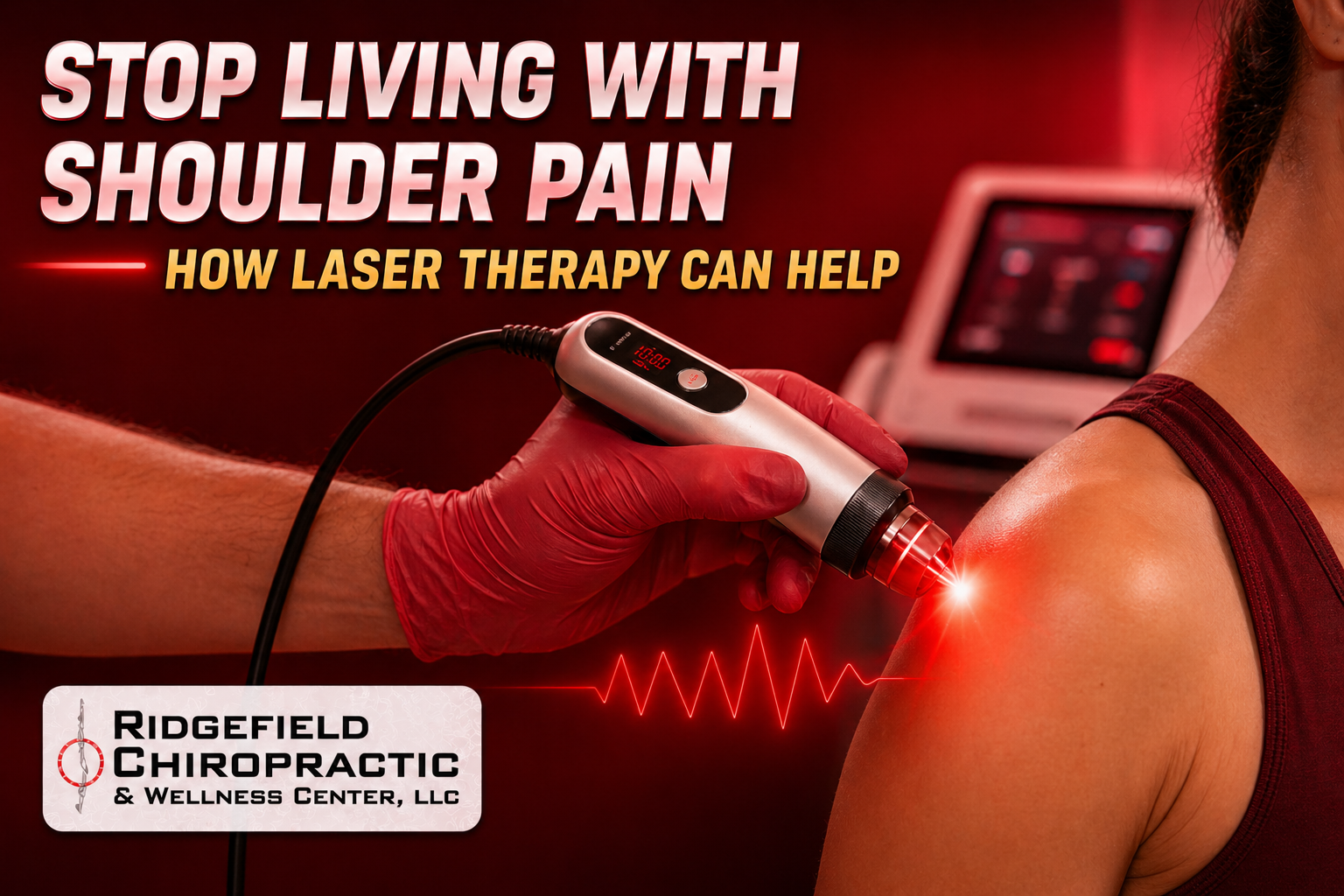
Think about the last time you tried to reach something on a high shelf, swing a golf club, or sleep comfortably on your side, and your shoulder stopped you cold. That dull, grinding ache that just won’t quit. The sharp bite of pain when you move the wrong way. The helpless feeling of watching your range of motion shrink a little more each week.
Shoulder pain is one of the most common and most frustrating musculoskeletal complaints we see at Ridgefield Chiropractic & Wellness Center. It limits your work, your exercise, your sleep, and your independence. And for far too many patients, the only options they’ve been given are anti-inflammatory medications, cortisone injections, or surgery.
But there’s another option for shoulder pain relief with laser therapy, one that’s backed by a growing body of clinical research, completely non-invasive, and delivering real results for patients with even chronic, stubborn shoulder conditions. It’s called Low-Level Laser Therapy (LLLT), also known as photobiomodulation, and it’s changing the way we treat shoulder pain.
What Is Laser Therapy, Exactly?
Low-level laser therapy uses specific wavelengths of light energy to penetrate deep into soft tissue — tendons, muscles, bursa, and joint capsules — where it triggers a powerful cellular healing response. Unlike surgical lasers that cut or ablate tissue, therapeutic lasers are gentle and completely painless. Most patients feel nothing more than a mild warmth during treatment.
See what our patient had to say about her chiropractic treatment and relief for her shoulder pain [patient video testimonial].
Here’s what’s actually happening inside your shoulder during a laser therapy session:
- Photons from the laser are absorbed by mitochondria inside your cells, supercharging their production of ATP — the energy currency your body uses to repair damaged tissue.
- Laser light stimulates the release of nitric oxide, which dilates blood vessels and dramatically increases circulation to the injured area, flooding it with oxygen and healing nutrients.
- It modulates inflammation — not by simply suppressing it (as medications do), but by moving the tissue through the inflammatory cycle more efficiently, reducing chronic, stuck inflammation.
- Collagen synthesis is accelerated, meaning torn or damaged tendons and connective tissue actually rebuild faster and more effectively.
In short, laser therapy doesn’t just mask your pain — it helps your body actually fix the problem.
Shoulder Conditions That Respond Exceptionally Well to Laser Therapy
Laser therapy is particularly effective for shoulder conditions that involve tendon, bursa, or soft tissue damage — the same conditions that tend to linger for months and resist conventional treatment. Here are the most common shoulder diagnoses we treat with LLLT at our Ridgefield office:
1. Rotator Cuff Tendinitis and Partial Tears
The rotator cuff is a group of four muscles and their tendons that stabilize the shoulder joint and power your arm movements. When these tendons become inflamed (tendinitis) or develop micro-tears from overuse or injury, the result is persistent aching pain, weakness, and difficulty lifting the arm above shoulder height. This is especially common in active adults, overhead athletes, and workers who perform repetitive shoulder motions.
Clinical research has demonstrated that laser therapy significantly reduces pain and improves function in rotator cuff tendinitis by stimulating tendon cell regeneration and reducing the chronic inflammation that keeps these injuries from healing on their own. For patients with partial tears who want to avoid surgery, LLLT combined with rehabilitation exercise is a compelling conservative option.
2. Shoulder Bursitis (Subacromial Bursitis)
The subacromial bursa is a small, fluid-filled sac that cushions the space between your rotator cuff and the bony arch above it. When this bursa becomes irritated and inflamed — from repetitive overhead activity, a fall, or even postural stress — it produces a deep, achy pain in the outer shoulder that worsens with reaching and lying on that side at night.
Cortisone injections are commonly offered for bursitis, but they come with significant drawbacks: repeated injections can actually weaken the surrounding tendon tissue over time, and they don’t address the underlying mechanical cause. Laser therapy reduces bursal inflammation directly, without those risks, and can be part of a comprehensive plan that also addresses the posture and movement patterns driving the problem.
3. Frozen Shoulder (Adhesive Capsulitis)
Frozen shoulder is one of the most debilitating and misunderstood shoulder conditions. The joint capsule becomes inflamed, then progressively scarred and thickened, causing steadily worsening pain and a dramatic loss of motion in all directions. It typically evolves through three stages: freezing (increasing pain), frozen (loss of motion), and thawing (gradual recovery). Untreated, it can take two to four years to resolve.
Laser therapy has been shown to meaningfully accelerate recovery from frozen shoulder by reducing capsular inflammation and promoting tissue remodeling. When combined with manual therapy and targeted mobilization exercises, it can significantly shorten the duration of all three stages, getting patients their lives back much faster.
4. Biceps Tendinopathy
The long head of the biceps tendon runs through the front of the shoulder and is a frequent source of anterior (front) shoulder pain, particularly with lifting, pulling, and overhead activities. Biceps tendinopathy can occur on its own or alongside rotator cuff pathology. It responds very well to laser therapy’s ability to stimulate tendon healing and reduce chronic degenerative changes in the tendon tissue.
5. Post-Surgical Shoulder Rehabilitation
If you’ve already had shoulder surgery — for a rotator cuff repair, labral tear, or other procedure — laser therapy can play a powerful role in your recovery. By accelerating tissue healing, reducing post-surgical inflammation, and minimizing scar tissue formation, LLLT helps patients regain strength and range of motion faster. It’s a natural complement to the physical therapy and chiropractic rehabilitation we provide.
What to Expect During a Laser Therapy Session
One of the things patients love most about laser therapy is how easy the sessions are. Here’s what a typical treatment looks like at Ridgefield Chiropractic & Wellness Center:
- Sessions are brief, typically 10–15 minutes, depending on the size and number of areas being treated.
- The handheld laser device is placed directly over the affected shoulder area. Protective eyewear is provided.
- The treatment is completely painless. Most patients feel only a gentle warmth or nothing at all.
- There is no downtime whatsoever. You can drive yourself home and return to your normal activities immediately.
- A typical course of treatment is 6–8 sessions, scheduled 2–3 times per week, though some patients notice meaningful improvement within the first few visits.
Why Patients Choose Ridgefield Chiropractic for Laser Therapy
At Ridgefield Chiropractic & Wellness Center, laser therapy doesn’t exist in isolation. Dr. Mascetta takes a comprehensive approach to your shoulder pain — which means understanding not just where it hurts, but why.
Depending on your specific condition, we may pair laser therapy with chiropractic care to address any cervical or thoracic spine involvement that contributes to shoulder dysfunction. We may integrate physical therapy exercises to restore the strength and movement patterns that protect the shoulder long-term. We may also incorporate soft tissue work, postural correction, or ergonomic guidance if work or lifestyle factors are keeping you injured.
This integrated, whole-person model is what sets us apart. We’re not just aiming to reduce your pain score — we’re aiming to restore your shoulder to full, confident function.
Common Questions About Laser Therapy for Shoulder Pain
Is laser therapy safe?
Yes. Low-level laser therapy has an excellent safety record and is FDA-cleared for musculoskeletal pain. It is non-invasive, drug-free, and carries no known serious side effects. Unlike medications, it creates no systemic burden on your liver, kidneys, or stomach.
How soon will I notice improvement?
Results vary by condition and individual, but many patients report reduced pain and improved mobility within the first 3–4 sessions. The full therapeutic effect builds over the course of treatment, and the results are durable — because the underlying tissue is actually healing, not just being temporarily numbed.
Is laser therapy a good alternative to cortisone injections or surgery?
For many patients, yes. Laser therapy can be an effective first-line or adjunct treatment before considering more invasive options. During your consultation, Dr. Mascetta will review your imaging, history, and clinical findings to give you an honest assessment of whether LLLT is appropriate for your specific situation, and what outcomes you can realistically expect.
Does insurance cover it?
Coverage varies by plan. Our team will help you understand your benefits and explore all available options during your initial consultation so there are no surprises.
Your Shoulder Deserves Better Than Masking the Pain
If you’ve been living with shoulder pain — whether it started last month or has been dragging on for years — laser therapy may be exactly what’s been missing from your treatment plan. It’s safe, it’s effective, and it addresses the root cause of your pain rather than covering it up.
We’d love to sit down with you, hear your story, and build a plan that actually works. Call us at (203) 431-1688 or email us at info@ridgefieldchiropractic.com to schedule your consultation. Your shoulder shouldn’t be the reason you stop doing the things you love.