
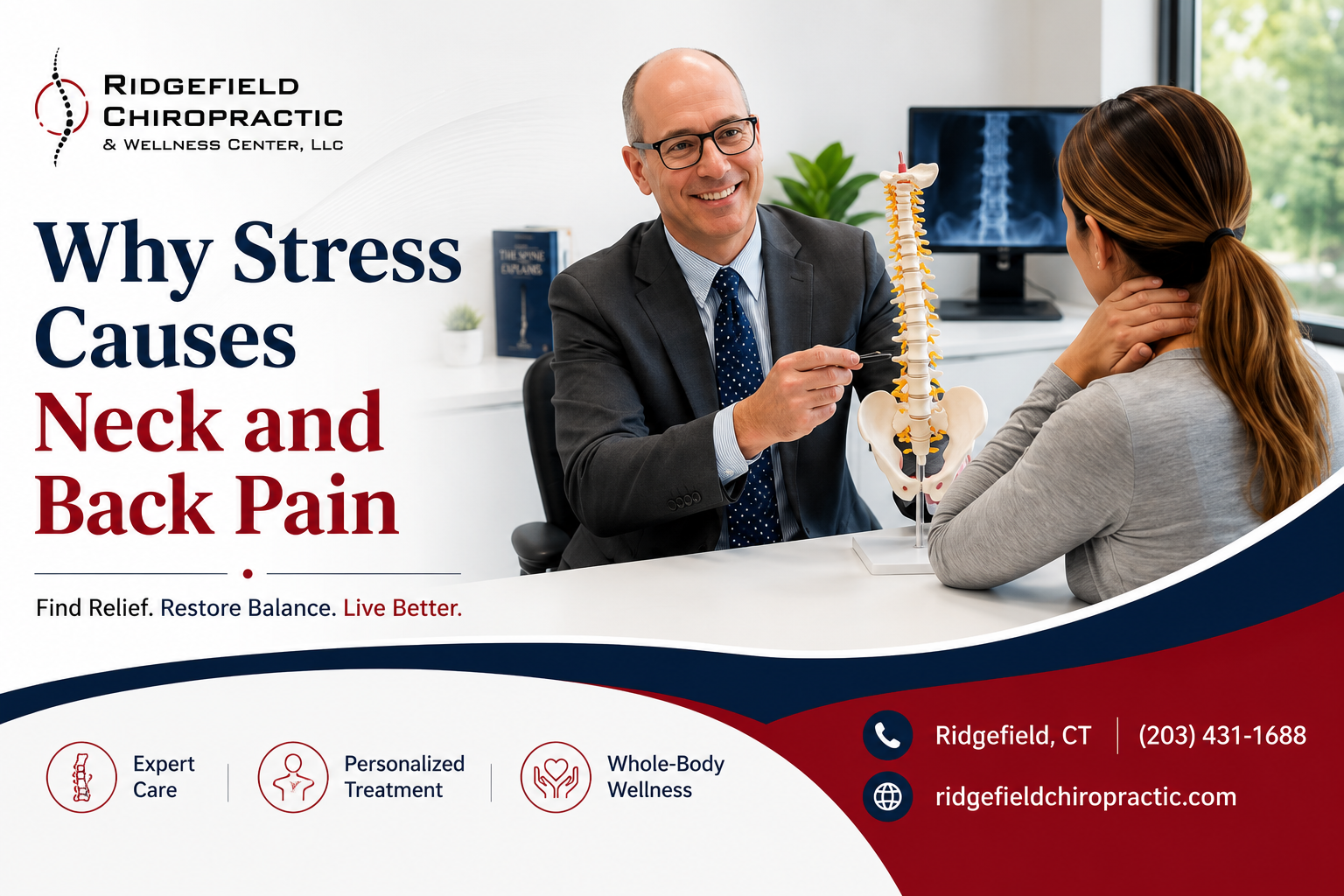
Have you noticed your neck feeling tight after a stressful workday or woken up with back pain for no obvious reason? You’re not alone. Many patients who visit Ridgefield Chiropractic & Wellness Center are surprised to learn that emotional stress can have a real impact on physical health. In many cases, neck and back discomfort begins or worsens during periods of ongoing stress, even without a specific injury.
Can Stress Cause Neck Pain?
Yes. Stress can cause neck pain by activating the body’s natural fight-or-flight response, which increases muscle tension in the neck, shoulders, and upper back. When this tension persists, it may contribute to stiffness, headaches, reduced mobility, poor posture, and ongoing neck and back pain. Understanding this connection is the first step toward addressing both the symptoms and their underlying cause.
Why Stress Can Lead to Neck Pain
The short answer is yes, and it happens more than most people realize. When you’re under pressure, whether from a demanding job, family responsibilities, or just the general pace of life in Fairfield County, your body reacts the same way it would to a physical threat. Your muscles brace themselves, your breathing gets shallower, and your shoulders tend to creep up toward your ears without you even noticing.
This muscular bracing is your body’s way of protecting itself. The problem is that most stress today isn’t something you can fight or run from. It’s an email inbox, a traffic jam, or a deadline. So the tension has nowhere to go. It just sits in your neck and upper back, day after day, until it turns into stress neck pain that doesn’t seem to have an obvious physical cause.
Patients often ask whether stress and back pain are really linked, or if they just have bad posture. In most cases, it’s both. Chronic stress makes posture worse, and poor posture makes stress-related pain worse. It’s a cycle that feeds itself.
How Stress Affects Your Muscles and Spine
When stress hormones like cortisol and adrenaline flood your system, your muscles contract as part of the body’s natural defense mechanism. The muscles most affected are usually the trapezius, the levator scapulae, and the muscles along the base of the skull. These are the same muscles that support your head, which weighs about ten to twelve pounds.
Held tension in these muscles pulls on the cervical spine, gradually shifting your posture and putting uneven pressure on the discs and joints in your neck. This is often where neck stiffness begins. Left unaddressed, that muscle tension from stress can spread down into the shoulders and upper back, affecting spinal alignment along the way.
The spine relies on balanced muscle support to stay properly aligned. When one group of muscles stays tight for too long while others weaken from disuse, your spine compensates by shifting out of its natural curve. Over weeks or months, this can lead to chronic neck pain, reduced range of motion, and a stiffness that seems to show up for no reason.
Common Signs Your Neck Pain May Be Stress Related
Not every ache in your neck comes from stress, but there are a few patterns that tend to show up together when it is the culprit. Patients frequently describe a tight band of discomfort that wraps from the base of the skull, across the shoulders, and down between the shoulder blades.
Common symptoms include:
- Neck stiffness that’s worse in the morning or after a long workday
- Shoulder tension, especially near the top of the shoulder blades
- Frequent headaches, particularly tension headaches at the base of the skull
- Upper back pain from stress that flares during busy or high-pressure periods
- Jaw tightness or clenching, sometimes without realizing it
- Poor posture, including a forward head position or rounded shoulders
| Symptom | Possible Cause |
| Tight band across shoulders | Muscle guarding from chronic stress |
| Recurring tension headaches | Tight neck and scalp muscles pulling on the skull |
| Jaw tightness or clenching | Stress-related teeth grinding (bruxism) |
| Forward head posture | Prolonged screen time combined with muscle fatigue |
| Reduced neck mobility | Sustained muscle tension limiting range of motion |
| Upper back tightness | Shallow breathing patterns during stress |
If several of these sound familiar, it’s worth paying attention to how your stress levels line up with your pain flare-ups.
Why Stress Often Leads to Back Pain
Stress doesn’t stop at the neck. It frequently travels down into the middle and upper back as well, and there are a few specific reasons why.
The first is muscle guarding, which is your body’s instinct to tense up around an area it perceives as vulnerable. When you’re anxious or overwhelmed, you may unconsciously hunch forward, which activates guarding in the muscles along your spine.
The second factor is posture changes. Stress tends to pull people into a more closed, protective posture: rounded shoulders, a dropped chest, and a forward-leaning head. Held over time, this posture places extra load on the muscles and ligaments supporting the spine.
Third, chronic stress is linked to low-grade inflammation throughout the body. While this isn’t the dramatic inflammation you’d see with an injury, ongoing low-level inflammation can make muscles more sensitive to pain and slower to recover from everyday strain.
Finally, stress often leads to reduced movement. People under pressure tend to sit longer, exercise less, and take fewer breaks, all of which allow stiffness to set in and worsen over time.
The Connection Between Stress, Posture, and Spinal Alignment
Posture and spinal alignment are closely tied to how your nervous system is functioning. Think about a patient who spends the workday hunched over a laptop while managing a stressful project. By the afternoon, their shoulders have rolled forward, their chin has crept toward the screen, and their lower back has lost its natural support from sitting so long without moving.
That posture, repeated day after day, gradually reshapes how the spine holds itself even outside of stressful moments. The muscles adapt to the position they’re held in most often, so a forward head posture from stress can eventually become a person’s resting posture, contributing to chronic neck pain and reduced flexibility.
This is one of the most practical reasons chiropractic care and posture correction go hand in hand. Addressing the alignment issue alone often isn’t enough if the underlying stress and habitual posture aren’t also addressed.
Can Chiropractic Care Help Relieve Stress-Related Neck Pain?
Chiropractic care can be a helpful part of managing stress-related neck and back pain, though it works best as one piece of a broader approach rather than a stand-alone fix. At Ridgefield Chiropractic & Wellness Center, care typically starts with a full posture evaluation to understand how stress may have shifted your alignment over time.
From there, a chiropractic adjustment can help restore more normal motion to joints that have become restricted from prolonged muscle tension. Soft tissue therapy is often used alongside adjustments to help release the tight muscles contributing to the pain, particularly around the neck, shoulders, and upper back.
Many chiropractors also incorporate mobility exercises designed to gently retrain the muscles and joints affected by stress, along with lifestyle recommendations covering posture, workstation setup, and simple stress management techniques. It’s worth noting that chiropractic care isn’t a guaranteed cure for stress itself. It’s most effective as part of a well-rounded plan that also includes rest, movement, and healthy coping strategies for the stress driving the tension in the first place.
Step-by-Step Guide: How to Reduce Stress-Related Neck Pain at Home
You don’t have to wait for pain to become severe before taking action. A few consistent habits can make a real difference.
- Stretch daily. Gentle neck and shoulder stretches, held for twenty to thirty seconds, can help release built-up tension before it becomes chronic.
- Stay hydrated. Muscles and spinal discs both rely on adequate hydration to function properly, so drinking enough water throughout the day supports tissue health.
- Set up an ergonomic workstation. Position your screen at eye level and keep your shoulders relaxed rather than hunched toward your ears.
- Practice breathing exercises. Slow, deep breathing activates the body’s relaxation response and can ease the muscle guarding associated with stress.
- Walk regularly. Even a short walk breaks up long periods of sitting and encourages better circulation to tense muscles.
- Prioritize sleep. Poor sleep makes muscles more reactive to stress, so a consistent bedtime routine supports recovery.
- Know when to seek care. If pain persists for more than a couple of weeks, worsens, or comes with numbness or tingling, it’s time to have it evaluated.
| Lifestyle Habit | Effect on Neck Pain |
| Prolonged screen time | Increases forward head posture and muscle strain |
| Regular stretching | Reduces muscle tightness and improves mobility |
| Poor sleep quality | Heightens muscle sensitivity and slows recovery |
| Frequent walking breaks | Improves circulation and eases stiffness |
| Deep breathing practice | Lowers overall muscle guarding from stress |
| Ergonomic desk setup | Reduces sustained strain on the neck and shoulders |
A Typical Patient Scenario
Consider a hypothetical patient, a Ridgefield office manager in her early forties, who came in describing several weeks of neck stiffness and afternoon headaches. She hadn’t had an injury or accident. Her days were simply long, filled with back-to-back meetings and a growing workload.
After a posture evaluation, it became clear her head was sitting noticeably forward of her shoulders, a pattern consistent with long hours at a laptop and rising stress at work. Her care plan combined chiropractic adjustments to restore neck mobility, soft tissue work to release the tight muscles at the base of her skull, and simple changes to her desk setup and daily stretching routine. Over several weeks, her stiffness and headache frequency both improved as her posture and stress habits shifted together. Cases like this are common, and they highlight why addressing posture and stress side by side tends to work better than treating either one alone.
When Should You See a Chiropractor?
Most stress-related neck stiffness improves with rest, stretching, and better posture habits. However, certain signs suggest it’s time for a professional evaluation:
- Pain that lasts longer than two to three weeks
- Pain that’s getting worse rather than better
- Numbness, tingling, or weakness in the arms or hands
- Headaches that are becoming more frequent or severe
- Pain that interferes with sleep or daily activities
- Neck pain following a fall, accident, or sudden movement
If any of these apply to you, it’s worth having your spine and posture evaluated rather than waiting to see if it resolves on its own.
Frequently Asked Questions
Can stress cause neck pain even without an injury?
Yes. Stress alone can tighten the muscles supporting your neck and spine, leading to stiffness and discomfort even when there’s no underlying injury. This is one of the most common causes of unexplained neck pain seen in practice.
Does stress cause neck pain on one side more than the other?
It can. Many people unconsciously hold more tension on their dominant side or the side they favor while working, which can lead to one-sided stiffness or discomfort.
How long does stress-related neck pain usually last?
It varies, but mild cases often ease within a few days to a couple of weeks once stress levels drop and posture improves. Persistent cases lasting longer may benefit from professional evaluation.
Can chiropractic adjustments help with stress headaches?
Chiropractic adjustments may help reduce tension in the neck and upper back that contributes to some tension headaches, though results vary and it isn’t guaranteed to resolve every headache type.
Is stress and back pain connected the same way as neck pain?
Yes, in many cases. Stress causes similar muscle guarding and posture changes in the upper and mid back as it does in the neck, often leading to discomfort in both areas together.
What’s the difference between stress-related neck pain and a pinched nerve?
Stress-related pain typically involves muscle tightness without radiating symptoms, while a pinched nerve often causes numbness, tingling, or shooting pain down the arm. A professional evaluation can help tell the difference.
Can posture correction alone fix stress-related neck pain?
Posture correction helps significantly, but it usually works best alongside stress management, stretching, and, when needed, chiropractic care to address both the alignment and the underlying tension.
Should I see a doctor or a chiropractor first for stress-related neck pain?
Either can be a reasonable starting point. If your pain is mild and has no warning signs like numbness or weakness, a chiropractor can evaluate your posture and spine. If you have more serious symptoms, start with your primary care doctor.
Conclusion
Stress has a real, physical impact on your neck and back, and it’s more common than most people expect. The tension it creates in your muscles can gradually shift your posture, strain your spine, and lead to the kind of chronic stiffness and headaches that are hard to shake without addressing the root cause. The good news is that small daily habits, combined with the right care when needed, can make a meaningful difference.
If stress-related neck or back pain has been affecting your day-to-day life, you don’t have to figure it out alone. The team at Ridgefield Chiropractic & Wellness Center is here to help you understand what’s going on and build a plan that fits your routine. If you’re in Ridgefield, CT or anywhere in Fairfield County and ready to feel more like yourself again, we’d be glad to have you come in for a consultation.